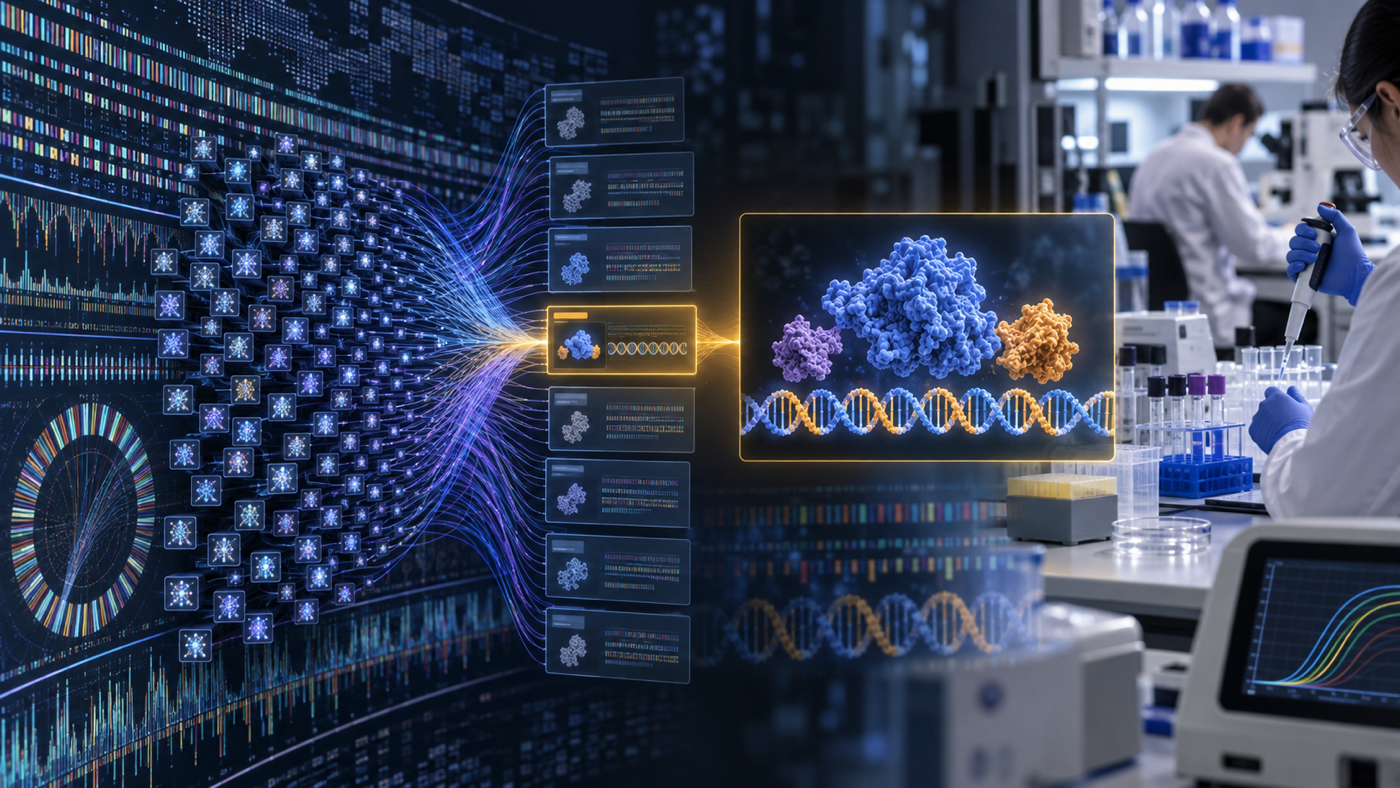
Anthropic says roughly 950 Claude agents searched genomic data for 21 hours, processing 210 million tokens. The agents examined more than 200,000 reverse transcriptases, identified 3,500 candidate systems, and narrowed them to 20 detailed reports.
One agent surfaced an unusual combination in bacteriophages: a reverse transcriptase, an accessory protein, and regularly spaced DNA repeats resembling the architecture of CRISPR systems. Anthropic calls the previously uncharacterized system array-associated reverse transcriptases, or ART.
Human scientists then investigated the candidate in Anthropic’s laboratory. Early experiments confirmed that ART’s repeat array produces distinct short RNAs, but its biological function remains unknown. The work is preliminary, has not yet been peer-reviewed, and does not establish ART as a working gene-editing tool.
Why it matters
The strongest signal is the agent workflow:
- hundreds of agents explored a large search space in parallel;
- automated filtering reduced thousands of candidates to a reviewable shortlist;
- agents produced human-readable evidence reports; and
- domain experts and laboratory experiments verified the promising result.
For builders, this demonstrates a practical architecture for discovery agents: parallel exploration, structured candidate ranking, durable reports, and external verification before a hypothesis is treated as a result. It is a concrete extension of the Claude Science workbench model from research assistance into a complete computational-to-laboratory loop.