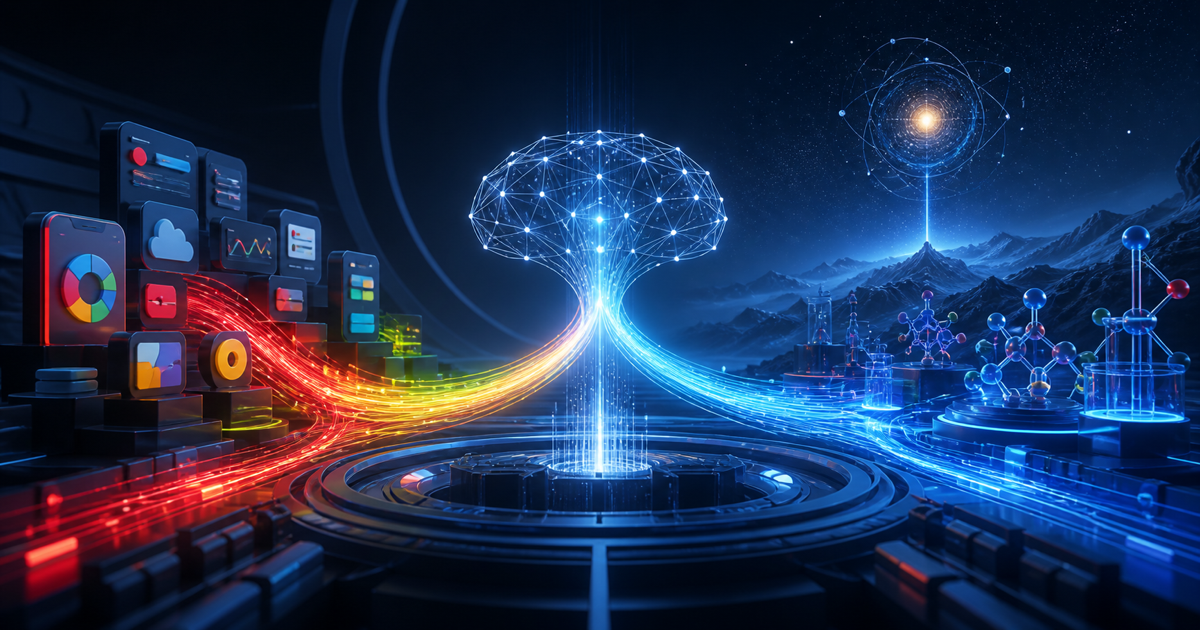
Google is reshaping its AI leadership at a pivotal moment. Demis Hassabis is moving from CEO of Google DeepMind to chair of the lab and chief scientist of Alphabet, a new role intended to concentrate his attention on artificial general intelligence, scientific discovery, and long-term AI strategy.
Koray Kavukcuoglu, previously DeepMind’s chief technology officer and Google’s chief AI architect, becomes senior vice president of Google DeepMind. He will lead the unit’s day-to-day work across model development, research, Gemini products, and developer teams while reporting to Alphabet CEO Sundar Pichai.
Google is separating research direction from execution
The structure matters more than the titles. Hassabis remains deeply involved in DeepMind as chair, continues leading the AI drug-discovery company Isomorphic Labs, and gains an Alphabet-wide scientific mandate. Kavukcuoglu takes responsibility for turning research into models, developer capabilities, and products that can ship at Google scale.
That division acknowledges a tension inside every frontier lab: the people and systems optimized to explore long-term scientific questions are not necessarily organized for fast, reliable product delivery. Google now appears to be making those two jobs explicit without breaking the connection between them.
Jeff Dean’s departure creates another center of AI research
Jeff Dean is also leaving Google after 27 years. The longtime research leader is forming a new company with several other senior AI researchers, and Google plans to invest in the venture. The move removes one of Google’s most influential technical figures from its internal organization while keeping a strategic connection to what comes next.
That arrangement reflects a broader pattern in frontier AI: valuable research may sit inside a major platform, in a specialized independent lab, or in a company backed by the platform it spun out from. Capital and compute can keep those organizations connected even when their reporting lines separate.
Why the reorganization matters
This is more than an executive reshuffle. Google is organizing itself for two AI races simultaneously: shipping competitive Gemini products now and pursuing more general intelligence over the longer term. One race is measured in release cadence, reliability, developer adoption, and distribution. The other is measured in scientific breakthroughs and capabilities that may take years to mature.
The company has unusual advantages in both. It owns a global product portfolio, cloud infrastructure, custom AI chips, frontier research teams, and the financial capacity to fund large experiments. But those assets only compound when research can cross into products and product feedback can return to research without organizational friction.
The new leadership design makes that interface the central operating question. Kavukcuoglu must translate DeepMind’s work into a coherent Gemini platform, while Hassabis must shape the longer arc without becoming the bottleneck for everyday execution.
The practical signal for AI builders
For businesses building with AI, Google’s move offers a useful operating model. Model capability, product execution, and scientific research are related disciplines, but they require different metrics and management rhythms.
- Research asks what becomes possible. It needs room for uncertain, long-horizon work.
- Platform engineering makes capability dependable. It turns experiments into stable APIs, tools, and infrastructure.
- Product teams decide what becomes useful. They translate capability into focused outcomes for real users.
- Distribution determines impact. Even a strong model needs clear positioning, access, and a credible adoption path.
Independent builders cannot reproduce Google’s scale, but they can adopt the same clarity. A product roadmap should not depend on every research breakthrough, and experimentation should not destabilize the customer experience. The stronger pattern is a controlled pipeline from capability scouting to prototype, evaluation, release, and measurement.
A clearer structure for the next phase of AI
Google unified DeepMind and Google Brain in 2023 to consolidate frontier research. This reorganization is a different kind of consolidation: it places day-to-day model and product execution under one operational leader while giving Hassabis a broader mandate to pursue AGI and science across Alphabet.
Whether it works will be visible in outcomes rather than titles—how quickly Gemini improves, how reliably research becomes product, and whether Google can retain the technical depth that made DeepMind distinctive. The strategic intent is already clear: the company no longer treats frontier research and AI product delivery as one management job.
Relevant links
- Google: Our next chapter of AI momentum
- Axios: Google DeepMind CEO Demis Hassabis is stepping aside
- Axios: Google’s AI leadership shuffle
- Google I/O 2026: AI and the frontiers of science
- SunMarc archive: Google is turning Gemini into a scientific research partner
- SunMarc archive: Google AI Mode turns Search into an agentic web