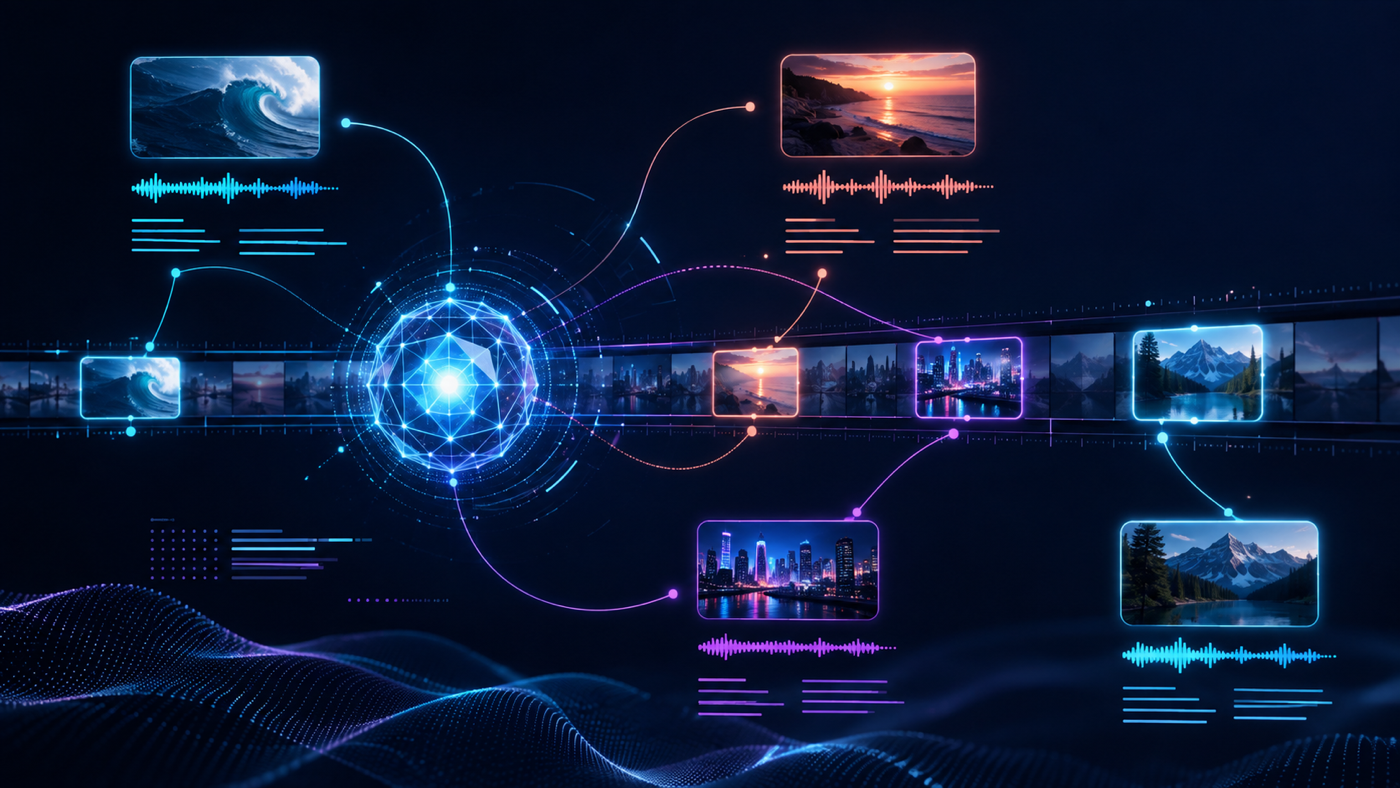
Google has introduced agentic video understanding for Gemini, replacing the usual “sample everything” approach with goal-directed video exploration. Instead of ingesting an entire video at a fixed frame rate, the model can search the timeline, inspect selected frames, consult audio or transcripts, and revisit relevant moments.
The capability launched for Gemini 3.7 Flash, 3.6 Flash, and 3.5 Flash-Lite through the Gemini API in Google AI Studio and the Gemini Enterprise Agent Platform. Google says the mode can use up to 88% fewer tokens, reduce analysis costs by up to 66%, and improve accuracy by up to 7% across its tests.
Those are vendor-reported best-case results, not guaranteed savings for every workload. Even so, the architectural change is significant: Gemini is no longer limited to watching a video in the sequence and resolution chosen before the request begins.
From fixed sampling to active exploration
Static video processing typically extracts frames at a fixed rate—one frame per second by default in Gemini—and places them into the model's context alongside audio. That approach is predictable, but it spends tokens on moments that may have nothing to do with the user's question. It can also miss a brief event that occurs between sampled frames.
Agentic processing gives the model an internal media-navigation loop. Gemini decides what to watch, at what speed, and through which modality. A question about a speaker's main arguments may lead it toward the transcript and selected visual evidence. A question about a split-second movement may trigger higher-frame-rate inspection of a narrow time window.
The response can expose media-processing tool calls and results, giving developers a way to confirm that the model actually navigated the video rather than relying on static sampling.
Why long-form video is the real opportunity
The strongest case is not a 30-second clip. It is a 90-minute lecture, a day of security footage, a library of sports recordings, or a long industrial inspection video where only a few moments matter. Processing every sampled frame can consume a large context window and make each query expensive.
Goal-directed exploration changes that cost structure. A meeting assistant can search for the segment where a decision was made. A training product can locate the demonstration that answers a learner's question. A media workflow can identify cut boundaries, repeated actions, or anomalies without treating every second as equally important.
Google highlights sub-second moment retrieval, long-form needle-in-a-haystack search, anomaly detection, and action or object counting as early use cases. These are useful precisely because they require the system to revisit and resample evidence rather than produce a summary from a single pass.
Efficiency depends on the question
Agentic processing is not automatically the fastest option. Google's documentation notes that short clips—especially those under five minutes—may have a slower time to first token because the model must reason about where to look and make internal tool calls before answering.
Static processing also remains appropriate when every frame matters, when latency must be highly predictable, or when the task requires a fixed sampling policy. The practical choice is workload-specific: agentic mode is attractive for long videos and targeted questions, while static mode can remain simpler for short, exhaustive analysis.
Developers should measure total tokens, latency, answer quality, and failure modes on their own content. The headline percentage is less important than whether the model consistently finds the evidence needed for the task.
What this means for builders
This release points to a broader product shift. Multimodal models are beginning to control how they acquire context instead of passively accepting a preprocessed input. That makes the model part of the retrieval system: it can decide which signals deserve more attention and spend compute selectively.
For app developers, the opportunity is not simply “summarize a video.” Stronger products will connect selective video inspection to a concrete workflow: search an archive, produce timestamped evidence, flag an anomaly for review, turn a lecture into study material, or extract clips for an editor.
The same principle applies beyond video. Useful agents manage attention. They decide when to search, what to inspect, which tool to call, and when the available evidence is sufficient. Agentic video understanding is a clear example of that transition from model-as-answer-box to model-as-active operator.
A benchmark for the harder problem
The VideoGAIA paper helps frame why this direction matters. Its benchmark moves beyond one-shot video question answering into multi-turn, tool-augmented tasks where systems must gather and combine evidence across interactions. The authors report that the frontier systems they tested remained below 60% accuracy across 271 expert-verified tasks.
That gap is a useful warning. Navigation improves the way a model gathers evidence, but it does not eliminate errors in perception, reasoning, or tool use. Products built on agentic video still need timestamped evidence, confidence-aware interfaces, human review for consequential decisions, and evaluation on the exact kinds of video they will process.
Relevant links
- Google: Introducing agentic video understanding with Gemini
- Gemini API: Video understanding documentation
- Gemini API: Optimization and inference guide
- VideoGAIA: A benchmark for agentic video understanding
- SunMarc: Gemini for Science shows where AI agents are headed next
- SunMarc: Google turns AI Search into an agentic web interface