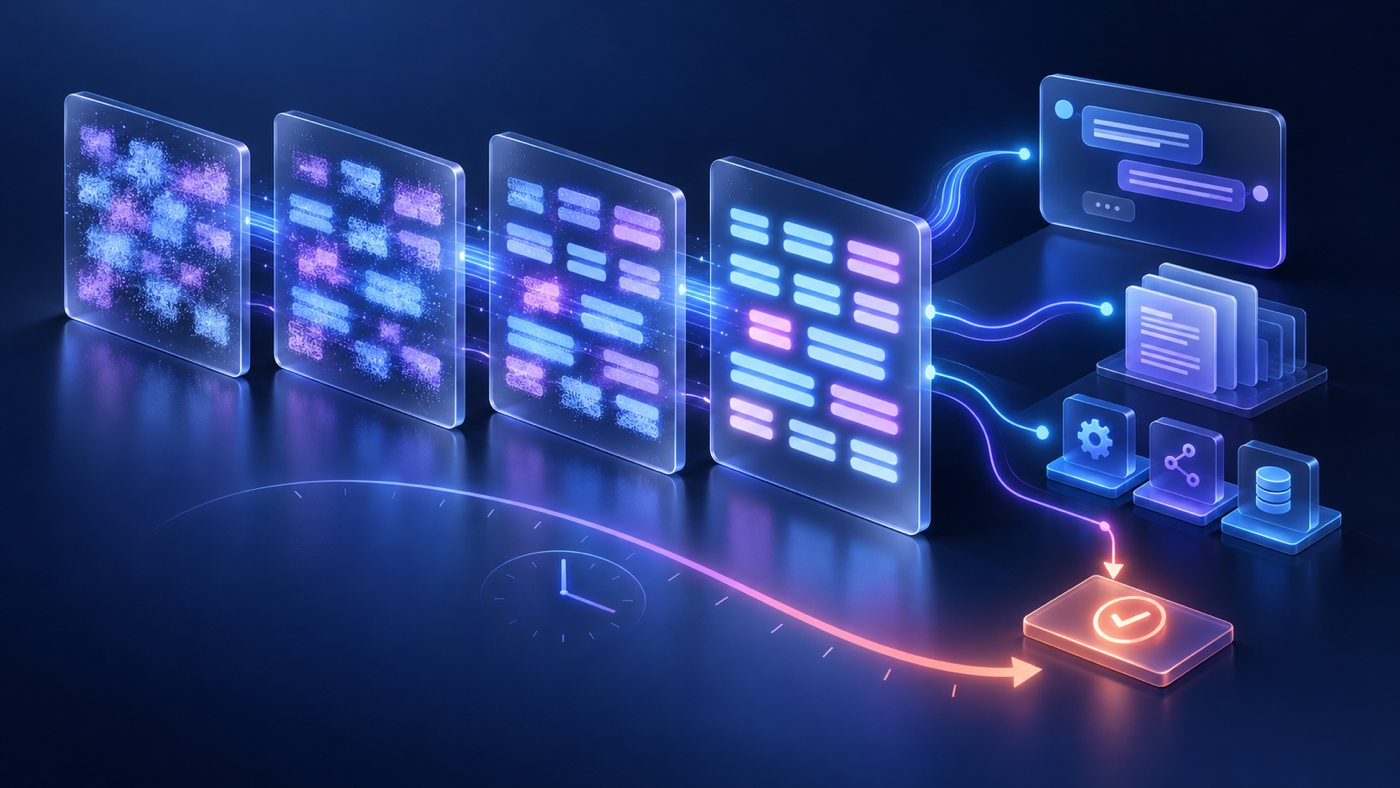
Inception released Mercury 3 on October 19, bringing a diffusion-based language model to its API, OpenRouter, Baseten, and Vercel. It generates text through parallel refinement—a different approach to making AI applications more responsive.
Long context, tools, and reasoning choices
The practical package includes a one-million-token context window, tool calling, structured outputs, and four reasoning settings: instant, low, medium, and high. Inception’s documentation says Mercury 3 defaults to low when reasoning effort is omitted.
Vercel’s October 19 changelog confirms Mercury 3 is available through AI Gateway, providing another hosted access route alongside Inception and its other providers.
Launch pricing is distinct from standard rates
Launch pricing is $0.10 per million input tokens and $0.35 per million output tokens. Those promotional rates are half the listed standard prices of $0.20 input and $0.70 output. Developers should check the current pricing page when estimating an ongoing workload.
Generation speed is not the whole task
Inception reports generation speeds of 1,068 tokens per second on NVIDIA GPUs and benchmark gains over GPT-6 Luna and Claude Haiku 5.5. These are vendor-reported results, not independently verified guarantees.
Agents make repeated model calls, so waiting time accumulates across searches, tool calls, and retries. Mercury 3 offers developers another option to evaluate for responsive assistants and multi-step workflows, but token-generation throughput alone does not measure time to a correct, completed task.
Why it matters for SunMarc
For SunMarc App Labs, a useful trial would compare an app-support or documentation assistant against its existing baseline: time to a useful answer, correct task completion, and total cost including retries.
The QR Remix user guide could supply a bounded knowledge source for that evaluation. This is a proposed test, not an announced assistant feature or a claim that SunMarc has deployed Mercury 3. The meaningful result is dependable help delivered sooner—not simply faster token generation.