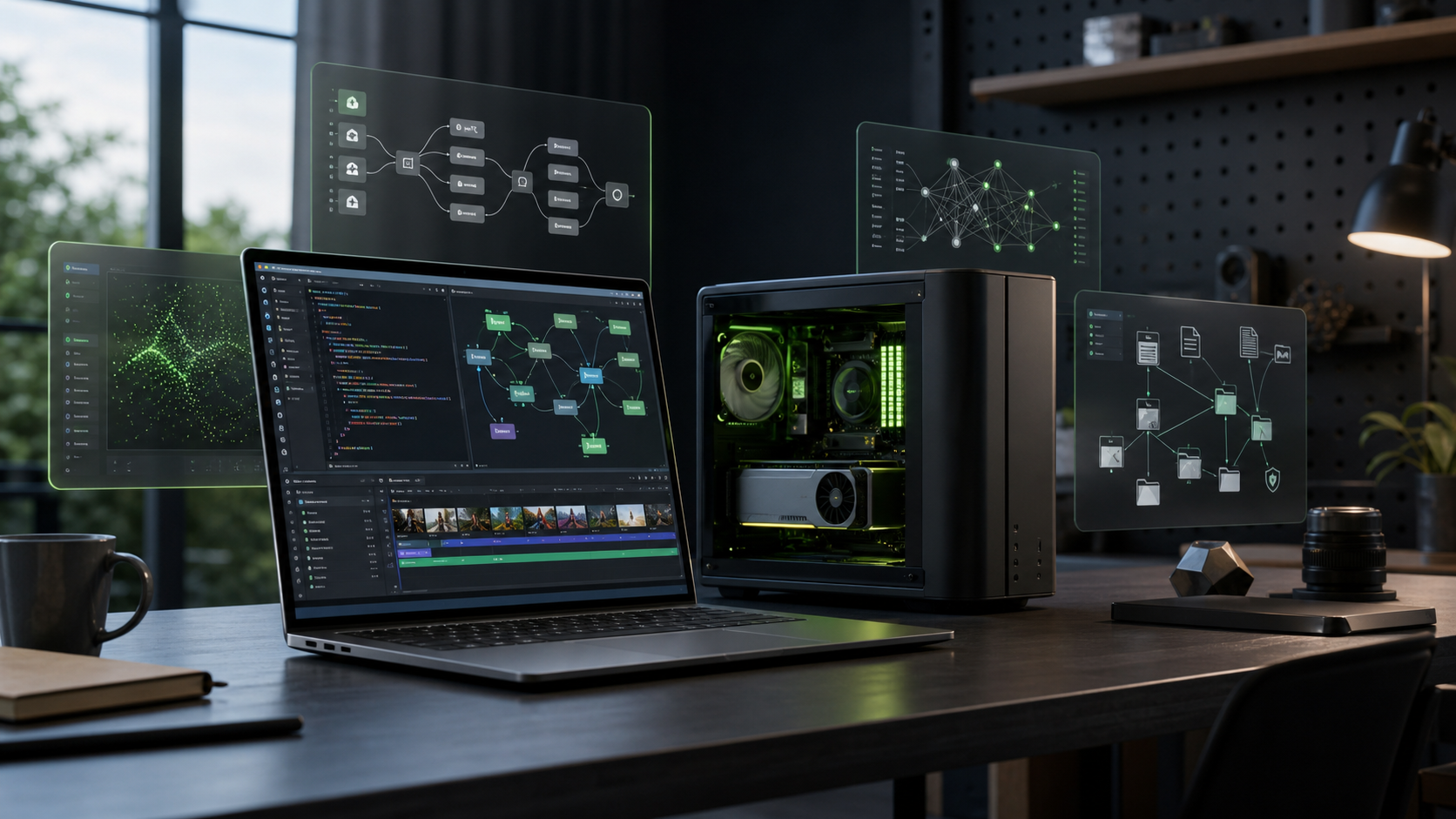
NVIDIA and Microsoft used Computex and GTC Taipei to frame the next Windows PC cycle around local AI agents. The new RTX Spark platform combines a Blackwell RTX GPU, Grace CPU cores, up to 128GB of unified memory, and up to 1 petaflop of AI performance for Windows laptops and compact desktops expected this fall.
The pitch is simple: instead of sending every assistant task to the cloud, Windows PCs should be able to run serious local agents for coding, research, creative editing, model workflows, and private file-aware automation. NVIDIA is selling the hardware headroom. Microsoft is trying to make Windows ready for the operating model.
The AI PC is becoming an agent machine
For the last few years, "AI PC" mostly meant a laptop with an NPU, a few local effects, and some Copilot branding. RTX Spark is a more aggressive version of the idea. NVIDIA describes it as a Windows PC platform purpose-built for personal agents, with enough local memory and compute for large models, multimodal workloads, and creative pipelines.
That changes the practical expectation. A local agent is not just a chatbot in a sidebar. It needs to read files, reason over project context, operate across apps, generate and edit media, write code, and keep the user in control. Those jobs are much harder if every step depends on remote inference, cloud round trips, and disconnected app permissions.
Microsoft's part is less flashy but important
Microsoft says it has been optimizing Windows for RTX Spark with workload profile scheduling, power and thermal management, unified memory support, Windows ML, TensorRT, and Arm app compatibility through Prism. The unified memory work matters because large local models and heavy creative scenes can become memory-bound before they become conceptually difficult.
The security story matters just as much. Microsoft is positioning new OS primitives around identity, containment, policy, and manageability so agents can run locally without being given unlimited trust. NVIDIA is pairing that with OpenShell, a runtime layer meant to help define what agents can and cannot do and how they route work between local and cloud models.
Creators and developers are the first obvious market
NVIDIA is not only pitching agents. It is pitching a complete RTX stack for people who already push machines hard: developers, designers, video editors, 3D artists, gamers, and AI builders. The company points to workloads such as huge 3D scenes, 12K video editing, local LLMs, 4K AI video generation, Adobe apps, Blender, ComfyUI, llama.cpp, and high-end gaming.
That mix is telling. The first useful local-agent PCs will not be judged only by whether they answer questions offline. They will be judged by whether they can sit inside real production loops: inspect a codebase, generate assets, search local files, summarize project state, batch-edit media, or run model experiments while the user keeps working.
Why it matters for builders
This is one of the clearest signs that the AI PC is moving from light copilots and NPUs into local agent infrastructure. If the platform works, developers and creators get faster experimentation, more private workflows, and less dependence on metered cloud inference.
The useful angle for app builders is practical: more users will have capable AI running locally on their own devices. That changes what web apps, desktop tools, browser workflows, and mobile companion experiences can assume about client-side intelligence.
It also raises the product bar. If a user's machine can run useful local agents, a thin app wrapper around a remote model will feel less defensible. The stronger opportunity is to design tools with clear task boundaries, user-owned data, local-first workflows where possible, and cloud escalation only when it adds real value.
The larger shift
The PC has always been personal because it stores a user's files, apps, preferences, and work history. AI agents need exactly that context. NVIDIA and Microsoft are betting that the next PC cycle will be about turning that context into action without making the cloud the only place intelligence can live.
There are still hard questions: price, battery life, app readiness, security defaults, Windows on Arm compatibility, model quality, and whether everyday users actually want always-available agents near their private files. But the direction is clear. The AI stack is moving down from the data center and into the machine on the desk.
That does not make cloud AI less important. It makes the split more interesting. The next generation of useful software will decide, task by task, what should happen locally, what should move to the cloud, and how much control the user should see before an agent acts.
Relevant links
- NVIDIA: NVIDIA and Microsoft Reinvent Windows PCs for the Age of Personal AI
- Microsoft Windows Blog: Introducing a powerful new chapter for Windows PCs, accelerated by NVIDIA RTX Spark
- AP: Nvidia bets on AI personal computers with new chip
- NVIDIA GeForce: Computex 2026 RTX Spark roundup
- SunMarc: Chrome's 4GB AI model shows the browser is becoming a runtime
- SunMarc: OpenClaw and the always-on operator pattern