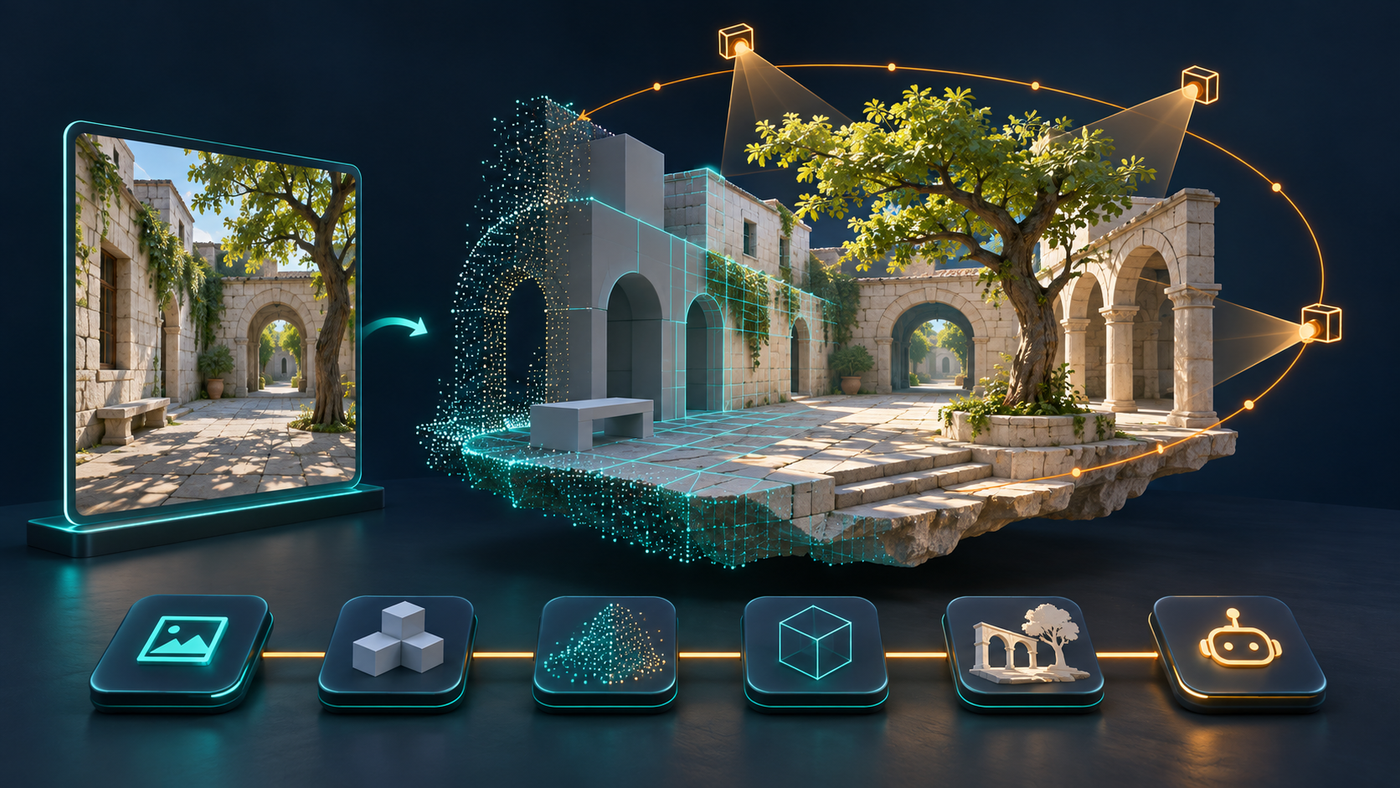
World Labs released Atlas tools and developer APIs on November 12, giving builders a way to generate and reconstruct 3D worlds inside their own workflows. This expands access to the model introduced in September—not a first announcement. The company's official timeline distinguishes the original model introduction from the tools and API release.
From a picture to a working scene
The practical shift is from generating a picture to working with a scene. The Atlas overview describes several tools:
- Viewfinder reconstructs worlds from images and renders camera paths.
- Chisel lets creators block out scenes and guide their structure.
- Splats to Mesh converts Gaussian splats into meshes for games and interactive environments.
- Developer integrations bring Atlas into existing tools, including Blender.
An agent-native route into 3D work
World Labs provides open-source agent skills and a CLI for camera flythroughs and 3D scene generation. The skills package the workflow instructions so a compatible coding agent can choose and run the relevant Atlas tasks.
A hosted MCP server also lets compatible assistants run Atlas tasks after account sign-in. This connects scene creation to an assistant's existing workflow; it does not mean that the model weights are downloadable or that tasks run for free.
Why it matters for builders
Developers can connect scene creation to the same agents already helping build software. For SunMarc App Labs, a useful first experiment would be a small game environment or promotional camera flythrough, evaluating export quality before committing to production.
That is a proposed evaluation, not a SunMarc hands-on result. Export quality, consistency across viewpoints and the amount of cleanup required will matter more than a striking first image. Our ERNIE creative-agent coverage looks at the related role of tool-using agents in game-development workflows.
Credits and capacity still shape the experiment
API tasks consume account credits. The billing documentation says task rates can change and directs developers to the current platform rate card. A multi-step scene workflow should therefore be evaluated by its total cost, not treated as one fixed-price generation.
Final per-task throughput quotas and commercial throughput tiers remain unpublished in the capacity documentation. Cost and consistency will determine whether these workflows move beyond prototypes. Builders can start with the developer quickstart and a bounded scene before planning a production pipeline.